The Walk-In Problem: How the CIA Almost Missed Adolf Tolkachev, the Billion Dollar Spy
The Man at the Gas Station
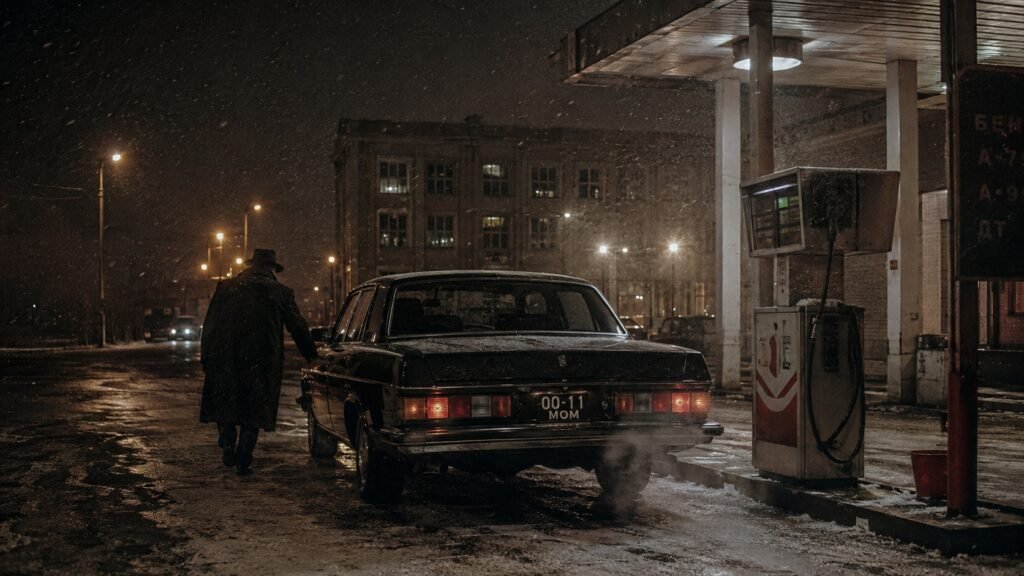
January 1977. Moscow. A gas station a short walk from the American embassy, on a freezing evening in a city where every foreigner assumed they were being watched.
A middle-aged Soviet man in a heavy coat approached a car with U.S. diplomatic plates. He rapped on the window. The driver rolled it down. The man asked to speak with an American. He said he had something Washington would want.
The driver waved him off.
The driver was Gardner Hathaway, chief of the CIA’s Moscow station. The most valuable Soviet volunteer of the Cold War had just knocked on the right car window in the entire USSR, and the American who answered treated him like a threat.
That was the correct response. Every case officer trained on the Moscow rules would have done the same thing. Volunteers who approach CIA officers in the KGB’s home city are almost always KGB. Almost.
Over the next thirteen months, the same man came back four more times. Different vehicles. Different American officials. He shoved letters through car windows. Once he pounded on the station chief’s car until the CIA officer drove away. Each time, Langley said the same thing. Do not engage.
His name was Adolf Tolkachev. He was an engineer at the Phazotron Research Institute in Moscow, where he had daily access to the Soviet Union’s most classified work on airborne radar and fighter avionics. He would go on to hand the CIA blueprints that reshaped the Cold War air balance and saved American defense programs billions in research.
But first, the agency he chose had to stop believing he was bait.
The Paradox of the Billion Dollar Spy
The nickname was not marketing.
The U.S. Air Force estimated that Tolkachev’s intelligence saved American defense programs roughly two billion dollars in R&D costs during his first year of production alone. His documents on Soviet radar, look-down and shoot-down capability, and fighter avionics reshaped how the Pentagon designed the F-117 stealth program and successive generations of electronic countermeasures. His portrait hangs inside CIA headquarters in Langley. He is the only Soviet source afforded that recognition.
He accomplished all of this while the CIA was almost giving up on him.
Between his first approach in January 1977 and his first phone contact with a CIA case officer on March 5, 1978, Tolkachev was ignored five separate times. He was flagged internally as a probable KGB dangle. Field officers were told, in writing, not to engage. His notes went unread for weeks. His persistence itself was treated as a warning sign, since KGB provocation agents were known for exactly that kind of behavior.
The paradox is not that Tolkachev was rejected. It is that he almost never got past the rejection at all. The Billion Dollar Spy is remembered as a triumph of American human intelligence. It was also, for more than a year, one of the closest calls in Cold War tradecraft. The Pentagon nearly never saw a page of what he had.
Understanding why requires understanding the specific problem the CIA was trying not to fall for. That problem has a name.
The Walk-In Problem
Every foreign intelligence service on earth has to make the same decision, over and over. A stranger approaches your officers and offers to spy for you. Do you take them at their word?
The mathematics of the answer is brutal.
Genuine volunteers exist, and some of the most damaging sources in intelligence history walked in on their own. Ryszard Kukliński gave the United States detailed Warsaw Pact war plans after approaching the American embassy in Bonn. Oleg Penkovsky approached Western tourists on a Moscow bridge in 1960 and went on to give away Soviet missile capabilities during the Cuban Missile Crisis. The walk-in is, statistically, one of the most productive channels in the trade.
Provocations exist too. In Moscow specifically, the KGB ran fake volunteers as a matter of routine. The point of the exercise was to identify American intelligence officers by tricking them into meetings. A CIA officer who accepted a bogus approach could be declared persona non grata, expelled, and burned as an operational asset for the rest of his or her career. Worse, the meeting itself gave the KGB grounds for a diplomatic incident that could damage broader U.S.-Soviet relations at a delicate political moment.
So the field math almost always favors caution. A rejected genuine volunteer costs you an unknown intelligence value, since you never learn what you missed. A rejected provocation costs you nothing. In the counterintelligence officer’s decision tree, no is the safe choice, and yes carries a career risk.
Benjamin B. Fischer, the former CIA historian who wrote about the Tolkachev case in the International Journal of Intelligence and Counterintelligence, has described the walk-in problem as one of the trade’s structural defects. The system is engineered to lose real sources in order to avoid embarrassing incidents. Most of the time, that is the correct trade. In one very specific case in January 1977, it almost was not.
Five Rejections in Thirteen Months
The first approach came in January 1977. Hathaway was at the wheel, and Tolkachev’s approach was later described in CIA declassified materials as almost improbably fortunate. Of every car with diplomatic plates in Moscow that night, he had walked up to the one containing the CIA chief of station.
Hathaway followed the book. He waved the man off, drove away, and reported the incident up the chain to Langley.
The second approach came weeks later. Tolkachev had watched cars entering and leaving the American embassy compound. He picked another set of diplomatic plates. This time he pushed a folded note through the car window before the American could respond. The note referred to specific Soviet aviation projects and hinted at his access.
Langley was suspicious. The information in the note was too tantalizing. In the paranoid arithmetic of Moscow station in 1977, the fact that a volunteer knew exactly what to say to catch American interest was itself evidence he had been coached.
He tried again. And again. And again. Between January 1977 and February 1978, five separate approaches. Each time, more of himself revealed. Each time, more specific claims about the work he did at his institute. Each time, the same institutional response. Do not engage.
Then, in February 1978, Tolkachev did something that broke the pattern. He handed one final letter through a car window. Eleven pages. He explained his motives, his access, the general categories of information he could deliver, and how he thought a secure channel might work. He also warned that if this letter was ignored like the others, he would stop trying.
Two things happened at Langley in parallel that shifted the calculation. The first was that the Pentagon had recently sent CIA an internal requirements memo asking for exactly the kind of intelligence Tolkachev claimed to possess. Soviet airborne radar development. Look-down capability. Fighter avionics. The bureaucratic coincidence was almost cinematic. The second was that CIA specialists conducted a handwriting and content analysis of the eleven-page letter and concluded that a KGB provocation officer would not have written it that way. The tradecraft in the letter was too honest. Provocations flatter and lead. This letter warned and offered.
On March 5, 1978, a CIA case officer named John Guilsher picked up a public telephone at the Bolshoi Theatre. He dialed Tolkachev’s home number. The two men spoke for the first time. It was thirteen months and one day after Tolkachev’s first attempt at the gas station.
Contact
Guilsher’s first call was short and coded. He identified himself using an alias Tolkachev had suggested in his letter. He confirmed the material had arrived and been read. He said the Americans wanted more.
The two men had to establish trust from a phone call, which is difficult under any circumstance and nearly impossible when one of them lives inside a state that will execute him if the wrong person hears the wrong sentence. The initial calls were limited to logistical questions and a slow build of protocol. Dead drops. Emergency signals. Duress phrases. The tools of the trade.
The first face-to-face meeting between Tolkachev and a CIA case officer did not happen until January 1, 1979. New Year’s Day. Ten months after the first phone call. Almost two years after the first knock on Hathaway’s car window.
Tradecraft governed every step of the interaction. Tolkachev’s Moscow station handlers ran surveillance detection routes lasting three or four hours before every meet. They changed clothes in stairwells. On at least one occasion, CIA officers used what they called the Jack-in-the-Box Ruse, a mannequin device that popped up in the passenger seat of a CIA vehicle after the officer had slipped out at a discreet moment, so KGB surveillance teams believed the vehicle still contained both occupants.
What Tolkachev handed over, beginning that January and continuing until 1985, would prove worth every day of the delay.
Inside the Vault: What Tolkachev Delivered
Tolkachev worked at Phazotron, the Soviet Union’s principal research institute for airborne radar and avionics. His clearance gave him access to the classified libraries where design bureaus stored their most sensitive work on the MiG-29, the Su-27, and the MiG-31 interceptor, along with the surface-to-air systems being deployed against U.S. cruise missile and low-altitude penetrator concepts.
He photographed thousands of pages of documents using a Pentax ME 35mm camera the CIA had smuggled into Moscow. Later he graduated to a Tropel subminiature camera small enough to fit inside a modified key fob. He shot pages during his lunch breaks, at home, in the men’s room of his institute. When he had exposed a roll, he passed it to his CIA handler at a dead drop location and picked up the next reel of film and the next set of one-time pads for encoded communications.
The volume was staggering. Over the seven years of the operation, he delivered tens of thousands of pages. The specific documents included complete technical specifications for Soviet look-down and shoot-down radar, jamming and counter-jamming capabilities, radar cross section research on Soviet aircraft, and the guidance systems used by air-to-air missiles carried on Soviet fighters.
The impact on American defense planning was almost immediate. The F-117 stealth program used Tolkachev’s radar data to validate design choices. The F-15 and F-16 electronic warfare suites were re-engineered around Soviet radar frequencies he identified. Air Force estimates from 1979 alone put the R&D savings to the U.S. taxpayer at roughly two billion dollars. That was the number that eventually gave him his nickname.
Tolkachev did not do this for money, though the CIA paid him well. He requested payments in rubles, which he received in stacks. He also asked for Western books, rock music tapes for his son, and specific consumer goods he could not obtain in Moscow. When the KGB arrested him in 1985, they later reported through the Soviet news agency TASS that he had been caught with two million rubles hidden at his home. He had spent almost none of it.
Twice during the operation he asked his handlers for a cyanide capsule. Twice they refused. On the third request, they gave him one, disguised as an ordinary pen.
How the Case Died: Howard, Ames, and Betrayal
Tolkachev did not die because of Soviet counterintelligence. He died because of American ones.
In 1983, a young CIA case officer named Edward Lee Howard was fired after failing a routine polygraph. He had been slated for a posting to Moscow station, where he would have been briefed on the Tolkachev operation before deployment. He was terminated before he could travel, but the pre-posting briefings had already begun. He knew enough to be dangerous.
Howard, bitter, alcoholic, and by 1984 in contact with Soviet intelligence in Vienna, gave the KGB what he knew. He may have given Tolkachev’s name directly. He certainly gave enough operational details that Soviet counterintelligence knew where to focus attention.
Then, in April 1985, a career CIA officer named Aldrich Ames walked into the Soviet embassy in Washington and volunteered his services to the KGB. Within weeks, Ames handed over the identities of every Soviet asset the CIA and FBI were then running, in what remains the most damaging single betrayal in the history of American intelligence. Tolkachev was on that list.
The KGB arrested Tolkachev in June 1985. His CIA-supplied cyanide pen was at home. He was taken to Lefortovo prison, interrogated for months, tried in a single day, and executed by firing squad in September 1986. His son learned of the execution when Soviet television broadcast a segment about the case.
The Politburo discussed the loss at length. A transcript of the September 25, 1986 meeting, later released by the National Security Archive at George Washington University, records General Secretary Gorbachev and KGB chief Chebrikov reviewing what Tolkachev had handed over. Chebrikov described the material as some of the most damaging Soviet intelligence hemorrhages of the Cold War.
At Langley, the fallout was different. Tolkachev’s operation had been one of the greatest human intelligence achievements in agency history. His death revealed that the same institutional pathology that had almost lost him at the beginning had, at the end, delivered him to his executioners. The counterintelligence paranoia that let Aldrich Ames operate undetected for nearly a decade was the mirror image of the paranoia that had rejected Tolkachev’s approaches in 1977. Same institutional organism. Opposite failure modes.
The Hard Baseline
The walk-in problem did not end with the Cold War.
It arguably worsened. In the post-Snowden environment, in the aftermath of the Vault 7 disclosures, in an era when a Russian intelligence officer defecting to a NATO country is now doing so against a service that has spent decades studying Western tradecraft, the signal-to-noise problem in volunteer recruitment is harder than it was in 1978. Every foreign intelligence officer knows the counterintelligence math: a rejected volunteer costs an unknown value. Every hostile service exploits that fact by seeding real approaches with fake ones.
Modern digital walk-ins add a further complication. Anonymous tips through encrypted channels, cryptocurrency-based drop mechanisms, submission portals hosted on the Tor network, all of it broadens the volume of approach traffic and narrows the human bandwidth to evaluate any single one. The 1977 Moscow station could ignore Tolkachev four times because there were only so many humans knocking on cars. A modern station might miss a Tolkachev-tier source in the daily inbox.
The lesson from January 1977 is not that CIA should trust every walk-in. That is the wrong lesson. The lesson is that institutional systems are engineered for one kind of failure, and the specific engineering of any single system determines which kind. Moscow station in 1977 was engineered to reject provocations, and it did that job. It also came within one eleven-page letter of missing the most valuable Soviet source of the Cold War.
The right question for any intelligence organization is not whether it is catching enemies. The right question is what kind of friend it might be turning away.