China Is Targeting America’s AI Policy Experts: Inside the TA419 Campaign
BLUF
A China-aligned espionage group spent at least eighteen months working the people around American AI policy. Not the model weights. The advisers.
Proofpoint disclosed the cluster on October 1, 2026 and tracks it as TA419. The targeting set included U.S. and Japanese think tanks, universities, defense contractors, and law firms. The lures were professional invitations. The payload was a Microsoft credential and session capture.
Nothing in the public record establishes that TA419 stole a single policy document. That gap matters, and this article keeps it visible. What the record does establish is target selection, and target selection is the intelligence story.
What Happened
The activity goes back to at least April 2025. That is the observation floor, not a founding date.
In February 2026, the operators impersonated an Anthropic employee and built the pitch around military use of Claude. Relevant topic, plausible sender, reasonable ask.
Beginning July 8, 2026, the impersonations shifted to policy figures: Lynne Parker and Heidi Crebo-Rediker. The invitations concerned an AI advisory committee and a Senate foreign relations report on export controls and supply chains.
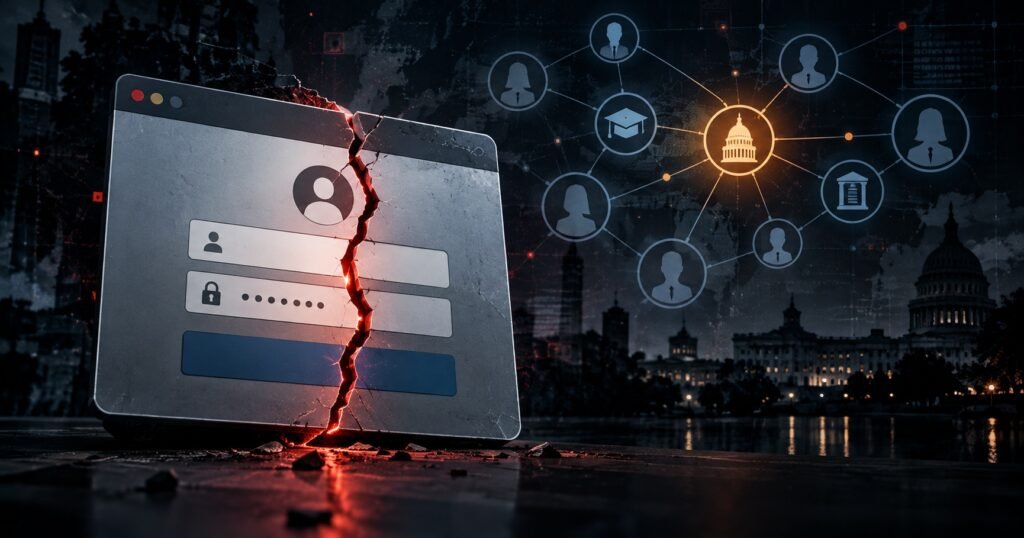
The operators waited for a reply before delivering anything hostile. Once a recipient engaged, shortened links carried them through fake OneDrive branding into a Microsoft session phishing flow. The technical stack combined browser-in-the-browser deception with an adversary-in-the-middle proxy and session cookie capture.
Reuters independently identified Alex Engler as a target. He checked the outreach against professional contacts and recognized the impersonation. Proofpoint told Reuters its observed targeting covered fewer than ten people across a handful of organizations, and assessed a policy intelligence objective.
Read that number correctly. It describes vendor visibility. It is not a victim count and it is not a ceiling.
Timeline
| Date | Evidence milestone | Why it matters |
|---|---|---|
| At least April 2025 | Earliest observed activity | Observation start, not origin |
| February 2026 | Anthropic impersonation | Military AI discussion supplied the pretext |
| Beginning July 8, 2026 | Policy figure impersonation | Operation predates its disclosure by months |
| October 1, 2026 | Proofpoint research and Reuters reporting | The date the public learned, not the date it started |
Three separate clocks run here: when the activity occurred, when it was detected, and when it was published. Collapsing them produces bad analysis.
Why an AI Policy Expert Is an Intelligence Target
Access, not prestige.
A senior title can sit outside the information flow. A mid-level coordinator can sit inside four of them. Collectors target the second person.
The policy community around AI runs on correspondence. Draft language circulates by email. Comment deadlines, read-aheads, working group invitations, and industry submissions all move through ordinary mailboxes belonging to people with no classified system and no government badge.
Counterintelligence has always concerned itself with that layer. The adversary rarely walks up to the decision. It walks up to the person who drafts the memo that shapes the decision.
What a Policy Mailbox Could Yield
The table below is an analytical framework. It describes potential value, not confirmed collection.
| Potential information | Possible intelligence value | Evidence required to prove collection |
|---|---|---|
| Unpublished policy drafts | Early warning on proposals and contested language | Access logs tied to specific documents |
| Export control discussions | Priorities, implementation friction, stakeholder positions | Correspondence plus attributed access |
| Calendars and meeting invitations | Participant mapping and decision timing | Calendar audit records |
| Contact networks | Advisers, intermediaries, and the next target set | Mailbox contents plus follow-on targeting |
| Legal and industry submissions | Arguments most likely to move policy | Specific accessed submissions |
| Military AI discussions | Deployment, procurement, and constraint concerns | Relevant records and confirmed entry |
One mailbox can function as a map of a policy community. The map is often worth more than any single document on it.
The Strategic Read
Technology competition includes competition to understand the other side’s decision process.
Technical theft answers what a capability is. Policy intelligence answers what will be restricted, when, and which arguments are winning. The two are complementary. A collector who knows which export control line items are under negotiation can position around them before the rule publishes.
Do not stretch this into a claim that technical theft has stopped. The record does not support that, and the two programs run in parallel in every documented case.
The Invitation as an Access Operation
The tradecraft deserves precision. This was cyber-enabled impersonation and social engineering. It was not a documented human recruitment operation.
The resemblance is real. Rapport building, authority borrowing, professional relevance. Those are HUMINT fundamentals. The collection mechanism is still a phishing proxy, and conflating the two produces sloppy analysis.
What made the approach work is that it asked for something normal. Contribute expertise. Join an advisory discussion. Review a report.
A reply is the hinge. Once the recipient has answered a message from a familiar name, the follow-up link feels like continuation rather than contact. No urgency. No panic. No greed. The operation runs on the target’s professional incentives, which are the hardest instinct to train out of anyone good at their job.
Three Questions for Any Approach
- Why would this specific person be useful to a collector?
- What makes this invitation credible inside that person’s working environment?
- What evidence separates an attempted approach from a successful compromise?
Question three is the one that gets skipped. The approach, the click, the authentication, and subsequent account access are four distinct events. Reporting that merges them overstates the damage every time.
Why a Real-Looking Microsoft Login Is Still Dangerous
Browser-in-the-browser deception draws a convincing imitation of a browser window inside a webpage. The address bar is a picture. The padlock is a picture.
The adversary-in-the-middle proxy is the harder problem. It relays a genuine authentication exchange to the real service while intercepting credentials and session artifacts in transit. The login works. The user sees what they expected to see.
A password is a request for access. A session artifact can represent access already granted. The analogy has limits, since tokens vary in scope, lifetime, and enforcement, but it gets the core right: stealing the second one skips the step where the first one is checked.
Microsoft documents malicious reverse proxies as a source of credential and token interception. This is a known failure mode, not an exotic one.
Not All Authentication Fails the Same Way
| Method | Behavior against an AitM proxy |
|---|---|
| Password only | No meaningful resistance |
| SMS or app-generated code | Code is relayed through the proxy like any other input |
| Push approval | Approval is granted against an attacker-mediated session |
| FIDO/WebAuthn | Origin binding prevents the credential from working on the attacker’s domain |
CISA recommends phishing-resistant authentication, specifically FIDO and WebAuthn. Origin binding is the operative difference. The credential will not authenticate to a domain it was not registered against, so the relay breaks.
Two cautions. Phishing-resistant authentication is one control inside a broader account protection program, not a finished answer. And a successful MFA event does not prove the legitimate user held the session afterward.
Do not claim this campaign defeats every conditional access policy, passkey deployment, or device restriction. The reviewed evidence does not say that.
What the China Attribution Actually Supports
Proofpoint assesses the activity as China-aligned. That assessment belongs to Proofpoint and should be attributed to Proofpoint.
No public evidence identifies a Chinese agency directing TA419. No public evidence names the operators. Strategic alignment is not agency tasking, and vendor attribution is not an indictment.
The policy intelligence objective is an assessment too, though a well-supported one. The targeting set and the lure content both point the same direction.
An Older Problem in a Newer Arena
In March 2024, the Department of Justice announced charges against seven alleged APT31 participants. The allegations described targeting of officials, politicians, companies, and others, including professional and personal email addresses. DOJ associated that program with China’s Ministry of State Security.
Those are allegations. The defendants are presumed innocent.
The comparison is bounded and useful: targeting the people around government decisions predates the AI debate by decades. The arena changed. The method did not.
It establishes nothing about TA419’s identity. Not the same group, not the same operators, not the same tasking authority. A strategic parallel is not an attribution link, and treating it as one is how analytical errors get laundered into accepted fact.
The same discipline applies to older collection cases. Insider recruitment produces comparable damage through an entirely different mechanism. Useful for understanding consequence. Useless for understanding this operation’s tradecraft.
What the Public Record Cannot Tell Us
| Claim | Publication treatment |
|---|---|
| China-aligned attribution | Attribute to Proofpoint. Do not upgrade to agency certainty |
| AI policy intelligence objective | Present as assessment, supported by targeting and lures |
| Fewer than ten targets | Explain observed visibility. There is no success denominator |
| Stolen emails or policy documents | Do not assert. No evidence of successful access and collection |
| U.S. policy was changed | Unsupported |
| Anthropic or the impersonated officials were involved | Impersonation establishes neither participation nor compromise |
| Attackers used AI to generate the messages | AI-themed targeting is not AI-assisted attack generation |
| A zero-day was required | The described sequence does not require one |
This case cannot support a compromise rate, a count of affected institutions, a financial loss figure, or a national security damage estimate. None of those denominators exist in the reviewed record.
Anyone publishing those numbers invented them.
Protecting the People Around AI Decisions
The following combines official security guidance with editorial recommendations for policy organizations. None of it describes observed TA419 post-compromise behavior.
Verify through an independently obtained route. A familiar name plus a credible topic is a reason to check, not proof of identity. Engler caught his by asking people he already knew. That is the control that worked in this case.
Prioritize phishing-resistant authentication for the exposed population. Researchers, advisers, and coordinators with sensitive correspondence first. Cover recovery methods and personal account exposure in the same plan, because collectors target the weaker of the two.
Build a reporting route that costs nothing to use. Early reports should be welcome even when nobody clicked anything. An organization that only hears about the successful ones learns nothing about the campaign.
Preserve the full thread. Headers, timestamps, link information, all of it. Do not revisit the link to investigate personally.
Investigate identity, mailbox, and cloud activity as one problem. Microsoft’s token theft playbook covers anomalous tokens, unfamiliar sign-ins, data access patterns, unknown authentication methods, and malicious inbox rules. Checking email alone misses most of that.
Contain with credential changes plus access and session revocation. Microsoft’s emergency access guidance notes that application sessions and token expiration affect when revocation actually takes hold. Do not promise instantaneous termination across every application, because it is not true.
Scope before you estimate damage. Determine what was accessed first. Then ask whether exposed correspondence creates follow-on risk for third parties who never received a single phishing message.
That last point is the one organizations consistently miss. A compromised mailbox exposes everyone in it.
The Perimeter Nobody Drew
The security perimeter around AI policy does not stop at the labs or the agencies. It runs through every adviser, fellow, counsel, and committee coordinator whose mailbox holds draft language and a contact list.
Those people operate without classified infrastructure, without security operations support, and usually without anyone treating them as a collection target. TA419 treated them as one. For eighteen months, with professional-grade pretexting, and with nobody noticing until a vendor published.
The open question is not whether this happens. It is how much of it is running right now below anyone’s detection threshold. Proofpoint saw fewer than ten people. Proofpoint saw what Proofpoint could see.
Related coverage: AI security incidents and exposure, a separate actor and a separate incident.