The OpenAI Bug Case: Why a $7 Microcontroller Just Rewrote US Counterintelligence Priorities
TL;DR. On October 13, 2026, federal prosecutors unsealed a criminal complaint against Abdulrahman Alfozan, a Saudi national and OpenAI engineer, charging him with planting a hobbyist microcontroller inside an executive conference room to intercept conversations about frontier AI. The hardware was crude. The target set was not. The complaint and the official statements around it mark the first time the federal counterintelligence apparatus has publicly treated an American AI lab as a protected national-security asset in the same frame it once reserved for aerospace and semiconductors.
The Device
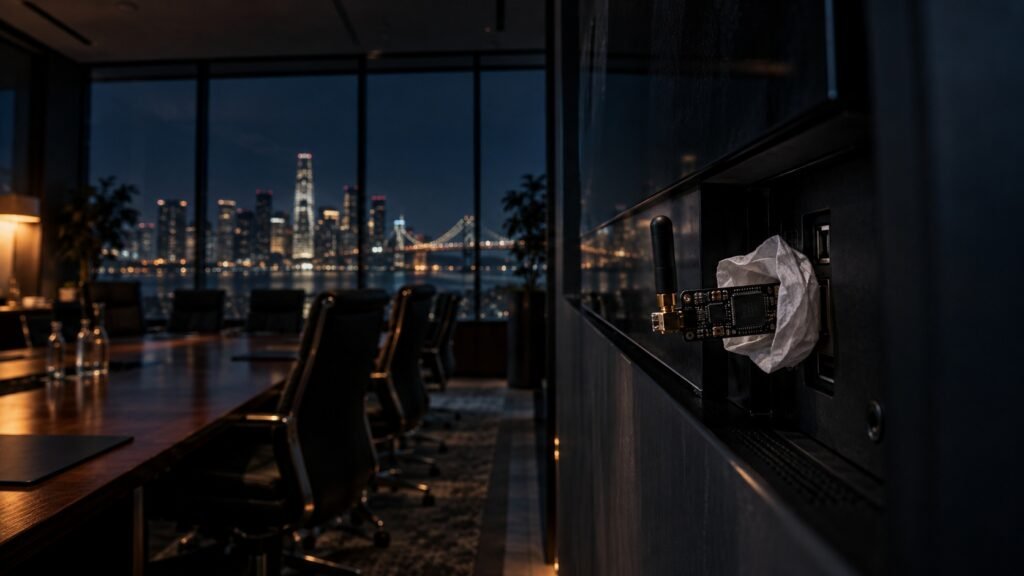
The hardware recovered from the back of a conference-room television at OpenAI’s San Francisco headquarters was a Seeed Studio XIAO ESP32-S3. It is a Chinese-manufactured microcontroller board aimed at hobbyists and students. Retail price, roughly seven dollars.
That is the entire physical story. A device the size of a thumbnail, concealed in toilet paper, plugged into a USB port behind a television, with an encrypted SD card. The Justice Department’s description reads less like a tradecraft dossier and more like a parts list from an electronics forum.
The modesty of the hardware matters, because it dates the moment. For decades, state surveillance of corporate targets implied specialist equipment, specialist handlers, and a budget. In 1982, Business Week quoted a Communications Control executive noting that a high school electronics student could already assemble a working audio bug for twelve dollars using off-the-shelf parts. The CIA was circulating that reporting internally the same year. Forty-four years later, the price curve has done what price curves do. The entry cost is a Mouser order and an afternoon.
The institutional cost is the part that has moved in the other direction.
What the Complaint Actually Alleges
According to the complaint filed in the Northern District of California, OpenAI personnel discovered the device on or about September 30, 2026. Forensic review placed its installation at approximately September 28. The contents were encrypted. The room in which it was found hosted meetings covering, in the government’s own phrasing, “proprietary research, product plans, and business-development opportunities, as well as nonpublic information about OpenAI’s technical progress and strategic decisions, capabilities, priorities, government engagements, and commercial relationships.”
That final clause is the one worth sitting with. More on it below.
The complaint traces a sequence of behaviors in the weeks before discovery:
- Alfozan used a workplace productivity tool to query OpenAI building addresses, meeting rooms, room capacities, scheduling calendars, and the physical locations of “leadership and exec” and external partner meetings.
- A chatbot account associated with Alfozan’s spouse, sharing identifiers and attributes with his own account, submitted a sequence of prompts between September 24 and September 30 covering, in the complaint’s quoted language, “build[ing] a continuous audio recorder,” “customiz[ing] Wi-Fi . . . connectivity,” “improv[ing] audio and live listening,” and “encrypt[ing] the SD card.”
- The same account submitted prompts referencing the device’s custom header and unique MAC address between September 27 and 28, the window during which the device was installed.
- Closed-circuit footage placed Alfozan near the executive conference room on multiple occasions, despite his having no authorization to attend meetings there.
- On October 5, footage captured him entering the room and appearing to inspect the area behind the television. The same day, he left a bag unattended in a different OpenAI building. Security personnel opened it and recovered a second recording device alongside his wallet and identification.
A separate court filing, unsealed later in the week, disclosed that Alfozan, his wife, and another family member had booked one-way tickets from San Francisco to Saudi Arabia via Istanbul, departing October 12. The FBI arrested him on October 9.
The Line Nobody Is Quoting
Return to the complaint’s description of what the executive conference room was used for.
“Government engagements.”
Four words, embedded in a boilerplate list, that quietly reframe the entire case. The target was not only OpenAI’s proprietary research and commercial plans. It was the room in which an American frontier AI company discusses its interface with the United States government. That category covers contracting, policy coordination, briefings, export-control conversations, and whatever else now flows between a lab of this scale and the federal apparatus.
A device recording those discussions does not steal intellectual property in the Levandowski sense. It generates foreign intelligence about American executive-branch posture toward frontier AI, derived from the private side of the conversation. That is a materially different problem, and it is why the response came from the National Security, Cyber & Special Prosecutions Section rather than a standard trade-secrets unit.
The Institutional Signal
The press release carries three features that deserve attention from anyone tracking how Washington is reorganizing itself around AI.
First, terminology. The Justice Department refers throughout to “super intelligence (SI), also known as artificial intelligence.” This is the first federal criminal filing to adopt “super intelligence” as a formal descriptor. The language is OpenAI’s. The adoption is the government’s. When prosecutors begin writing an industry’s self-description into statutory charging documents, a line has been crossed in how that industry is categorized for enforcement purposes.
Second, the roster. FBI Director Kash Patel issued a statement describing the protection of “American SI innovation” as “one of our highest counterintelligence priorities.” He thanked Director of National Intelligence Jay Clayton by name. The Special Agent in Charge of the FBI’s San Francisco Field Office, Scott Schelble, framed the Bay Area innovation ecosystem as the protected object. Three principals, three statements, one message. The federal counterintelligence enterprise is now explicitly in the business of defending AI labs.
Third, the prosecuting section. The National Security, Cyber & Special Prosecutions Section of USAO-NDCA, not the general criminal division, carries the case. That assignment is the clearest institutional tell in the entire filing.
A Comparable Case Worth Studying
The cleanest historical parallel is United States v. Xu Yanjun, the 2018 arrest and 2022 conviction of a deputy division director of China’s Ministry of State Security for conspiracy to commit economic espionage against GE Aviation. Xu, operating under an alias, cultivated an engineer at GE Aviation over a period of years, requested proprietary files on composite fan blade technology, and was lured to Belgium and arrested in a cross-border FBI operation.
The parallels and the distinctions are both instructive.
| Element | Xu Yanjun / GE Aviation (2018) | Alfozan / OpenAI (2026) |
|---|---|---|
| Target sector | Aerospace (composite fan blades) | Frontier AI (super intelligence research) |
| Tradecraft | Classical HUMINT: alias, cultivation, cutouts, foreign travel | Insider access + hobbyist hardware + consumer AI tools |
| Collection vector | Document exfiltration via a cultivated engineer | Audio capture via planted device + reconnaissance via chatbot queries |
| Attribution | MSS, confirmed at trial | Not alleged in complaint; defendant is Saudi national, no service named |
| Prosecuting section | DOJ National Security Division | USAO-NDCA National Security, Cyber & Special Prosecutions Section |
| Signal | Foreign intelligence services targeting US aerospace is a federal priority | Foreign intelligence collection against US frontier AI is a federal priority |
The Xu case established the pattern. The Alfozan case extends it to a new sector and adds something the Xu case did not have: the complaint reads like it was built as much from digital exhaust (chatbot query logs, productivity-tool search history, badge data, CCTV) as from classical investigative method. The adversary’s tradecraft got cheaper. So did the defense’s evidence collection.
What We Do Not Know
Responsible analysis stops at the water’s edge. The complaint does not allege foreign direction. It does not name a service. It does not charge Alfozan’s wife. The government has stated it has no indication that model weights, source code, or customer data were improperly accessed or exfiltrated.
Reasonable open questions, flagged as open:
- Was Alfozan self-tasked, informally encouraged, or formally directed? The complaint supports none of these yet.
- Did the recordings reach anyone before the device was recovered? The contents were encrypted and the government has not publicly described decryption results.
- What role, if any, did his spouse play beyond the shared chatbot account? She is not charged.
- Why the one-way tickets, and why that date? The sealing motion treats it as flight risk. The timing suggests awareness.
- Which Saudi institutional affiliations, if any, bear on the case? His public bio lists Venture Partner status at RAED Ventures, a Riyadh-based firm with Saudi institutional backing. That is public record. It is also, standing alone, not evidence of anything.
Anyone writing this story with more certainty than the complaint supports is doing so from somewhere other than the complaint.
Key Takeaways
- The hardware was a $7 Chinese-manufactured hobbyist microcontroller. The entry cost of corporate audio surveillance is now effectively zero.
- The target was not only OpenAI’s intellectual property. It was the room where OpenAI discusses its interface with the US government.
- The federal counterintelligence apparatus has now formally entered the business of protecting American AI labs as a national-security sector. Three principals said so on the record.
- “Super intelligence (SI)” is now a term of art in a federal charging document. The implications of that linguistic choice will outlast this case.
- The investigative evidence base ran heavily on digital exhaust: chatbot query logs, productivity-tool search history, badge data, CCTV. The adversary and the defender are both operating in the same consumer-AI environment.
- The historical parallel is Xu Yanjun / GE Aviation. The pattern of foreign intelligence collection against protected US tech sectors is not new. The sector list just grew.
- Open questions remain, and the complaint does not resolve them. Treat anyone claiming otherwise with the appropriate skepticism.