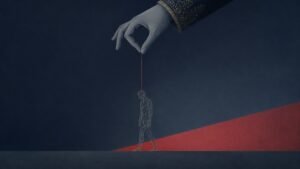
Information Warfare: How Russia, Iran, and China Fight America Without Firing a Shot
KEY JUDGMENTS:
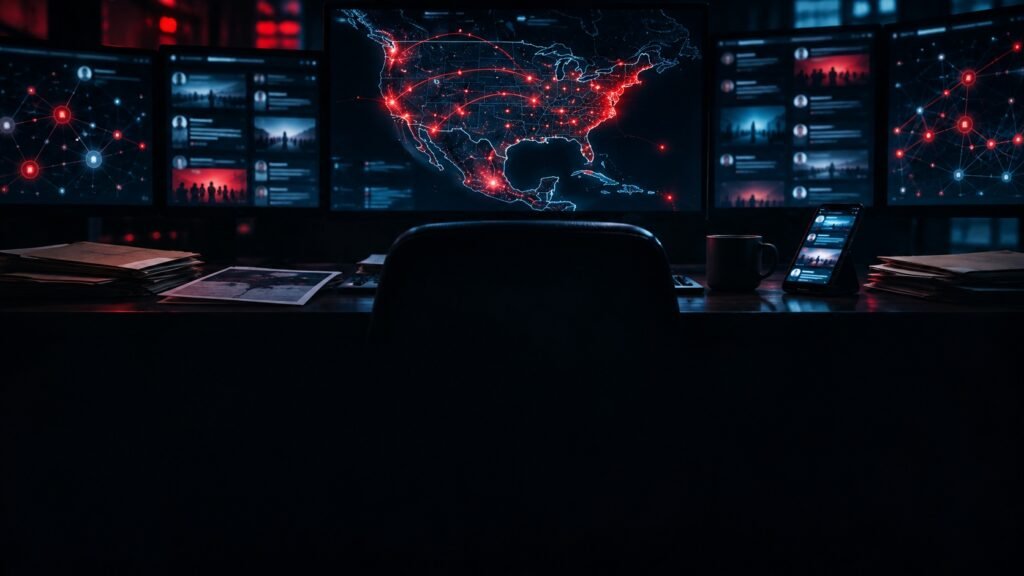
We assess with high confidence that Russia, Iran, and China are running sustained influence operations against American audiences. Information warfare is the one front where U.S. adversaries already engage Americans directly. Each country pursues different goals, but all three mainly exploit divisions that already exist rather than creating new ones. We assess with moderate confidence that these operations rarely persuade on their own, and that their real impact comes when American voices carry adversary narratives into domestic audiences.
Has WW3 Already Started on the Information Front?
The debate over whether WW3 has started usually focuses on missiles, tanks, and troop movements. That misses where the fighting is most constant.
In March 2022, former National Security Council official Fiona Hill described Russia’s approach to conflict to CBS News. She listed propaganda, cyberattacks, ransomware, information operations, and criminal groups. Ted Koppel asked whether that meant the world was already in World War III. Hill answered: “Exactly.”
Others have since built the historical case. In an August 2026 column, New York Times columnist Bret Stephens argued that World War II didn’t begin in 1939. It grew out of separate regional crises, starting with Japan’s invasion of Manchuria in 1931, that gradually linked together. He sees the same pattern today. Wars in Ukraine and the Middle East draw on the same stockpiles. Russia, China, Iran, and North Korea trade weapons and intelligence with one another.
Skeptics push back hard. In a November 2026 report for the Toda Peace Institute, Robert Muggah concluded that the evidence does not show World War III has begun. A September 2026 analysis in the Lowy Institute’s The Interpreter, by defense strategist Al Hynes, made a sharper point. What made the two world wars different was domestic depth: the mobilization of entire societies at home. Geographic breadth wasn’t the defining feature.
That test is useful, and it cuts in an unexpected direction. On the battlefield, no major power has mobilized its society for a world war. On the information front, the fighting already reaches inside American homes, phones, and elections. Adversaries don’t need to mobilize their own populations to fight it. They work on ours.
Analysts can argue about the label. On one point, though, the record is clear. Foreign governments are running influence campaigns against Americans every day, and many of the targets never know it.
];pl\
What Is Information Warfare?
Information warfare is the use of information to gain an advantage over an adversary. It targets what people believe, what they trust, and how they make decisions.
The term covers a wide range of activity:
- Propaganda: openly state-backed messaging, such as Russia’s RT or China’s CGTN
- Disinformation: deliberately false content designed to deceiveb
- Influence operations: coordinated campaigns that hide their true sponsor
- Hack-and-leak operations: stealing information and releasing it at a damaging moment
- Amplification: boosting real Americans who already say what an adversary wants said
The last category is the most important and the least understood. A foreign government doesn’t need to write a message if an American with a million followers will say it for free.
Two terms get confused constantly. Misinformation is false information spread without intent to deceive. Disinformation is false information spread on purpose. A Russian operative writes disinformation. The American who shares it without checking spreads misinformation.
The Main Types of Information Warfare
Military doctrine treats information warfare as a family of related disciplines. The U.S. military now groups most of them under the term information operations.
| Type | What it targets | Example |
|---|---|---|
| Psychological operations | Beliefs, emotions, and morale | Leaflets urging enemy troops to surrender |
| Electronic warfare | Communication systems and signals | Jamming radios or spoofing GPS |
| Cyber operations | Information systems and critical infrastructure | Hacking a utility or a campaign’s email |
| Military deception | An enemy commander’s decisions | Fake buildups that hide the real attack |
| Influence operations | Public opinion in another country | Covert social media campaigns |
The idea is ancient. Sun Tzu wrote that all warfare is based on deception. What changed is reach. Leaflets once had to be dropped from aircraft. Today a message can reach millions of phones in another country within an hour.
This article focuses on the last category, because it’s the one aimed at ordinary Americans.
Information warfare is also cheap. A fake news site costs almost nothing. A fabricated video costs a few hundred dollars. A tank costs millions. For a country that can’t match the United States militarily, that math is hard to resist.
Active Measures Never Ended
Russia’s playbook is old. Soviet intelligence called it aktivnye meropriyatiya, or active measures. The KGB used forgeries, front groups, planted stories, and paid agents to shape foreign opinion throughout the Cold War.
The best-known example is Operation INFEKTION. In 1983, a pro-Soviet newspaper in India published a letter claiming the U.S. Army created AIDS at Fort Detrick, Maryland. The KGB then laundered the story through sympathetic outlets and scientists. By the late 1980s, it had appeared in media in dozens of countries. Versions of it still circulate today. In 2020, a Chinese foreign ministry spokesman revived the template, suggesting the U.S. Army may have brought COVID-19 to Wuhan. Fort Detrick appeared in that pandemic conspiracy too.
INFEKTION established the method. Plant a claim in a distant outlet. Cite that outlet elsewhere. Repeat until the origin disappears and the claim feels like common knowledge.
Russian military thinkers built on this with a concept called reflexive control. The idea is to feed an adversary information that leads them to make a decision that benefits Moscow, while believing it was their own choice. The best influence operation is one the target never notices.
Modern operations follow the same logic. The tools have changed. The doctrine hasn’t.
The Modern Playbook
Russia’s Internet Research Agency, the St. Petersburg troll farm behind fake American personas in the 2016 election, showed what cheap social media operations could do. Today’s operations are more sophisticated and harder to trace.
State Media
Openly state-funded outlets form the visible layer. RT and Sputnik for Russia, Press TV for Iran, and CGTN and the Global Times for China all publish in English for Western audiences.
Their reach is limited on their own. Their real value is as a source. Their content gets clipped, reposted, and quoted by accounts that don’t disclose where it came from.
Fake News Sites
Russia’s Doppelganger campaign built websites that imitated real Western news outlets, copying their design and logos to publish fabricated articles. In September 2024, the Justice Department seized 32 domains tied to the operation.
Doppelganger also created original “independent” outlets that pushed the same content while appearing to be run by local journalists. Readers saw a small news site. They were actually reading the Kremlin.
Fabricated Videos
The most prolific current Russian operation is known as Storm-1516. It stages fake videos, often with paid actors or AI-generated deepfakes posing as whistleblowers or witnesses, then launders them through accounts with large followings.
Bloomberg News identified more than 190 fabricated stories tied to the operation between August 2023 and March 2026. More than 40 percent targeted Ukraine. A German intelligence assessment has tied the operation to Russian military intelligence and to networks financed by oligarch Konstantin Malofeyev.
Storm-1516 was active again in the 2026 midterms. In October, researchers attributed a baseless accusation against a Democratic U.S. Senate candidate to the operation.
Paid Influencers
The Tenet Media case is the clearest documented example of a foreign government paying for American voices.
In September 2024, the Justice Department charged two RT employees with secretly funding a Tennessee-based content company. Prosecutors said that between October 2023 and August 2024, RT sent more than $9.7 million through overseas shell companies, nearly 90 percent of the company’s deposits. The company produced nearly 2,000 videos that drew more than 16 million YouTube views.
The influencers on the platform said they didn’t know where the money came from, and none were charged. That detail is the point. The operation was designed so the talent wouldn’t know. Their audiences certainly didn’t.
AI Chatbot Poisoning
The newest front targets machines instead of people. A Moscow-based network known as Pravda publishes millions of articles aggregated from Russian state media and pro-Kremlin influencers. NewsGuard found the network put out 3.6 million articles in 2024.
The goal isn’t human readers. It’s the data that AI chatbots learn from and search. In a NewsGuard audit of 10 major chatbots, the systems repeated Pravda network narratives about a third of the time. Researchers call this LLM grooming.
If your search engine or AI assistant answers a question about Ukraine, the answer may already be shaped by a Russian content farm.
Front One: Ukraine
Ukraine is the central target of Russian information warfare, and the narratives are consistent:
- Ukraine is hopelessly corrupt, so aid is wasted
- Russia is winning, so supporting Ukraine only prolongs the killing
- NATO provoked the war, so Russia is the victim
- Zelensky is illegitimate, a puppet, or both
- American aid money is stolen or funds luxury purchases
Some of these contain fragments of truth. Ukraine has had real corruption problems. That’s what makes the narratives effective. A claim built on a real problem is harder to dismiss than a pure fabrication.
The objective is not to make Americans love Russia. It is to make them tired, cynical, and convinced that helping Ukraine is pointless. If enough voters believe that, political pressure does the rest.
Front Two: Israel and the Gaza Divide
The war in Gaza opened a different front, and Iran is the main documented actor.
In July 2024, Director of National Intelligence Avril Haines said Iran was becoming increasingly aggressive in its influence efforts. She said actors tied to Iran’s government were posing as activists online, encouraging protests over Gaza, and in some cases providing financial support to protesters.
Haines was careful to add a caveat. She said Americans participating in the protests were expressing their views in good faith and that the intelligence did not indicate otherwise.
That caveat is the correct analytic frame. Iran did not create American opposition to Israel’s conduct in Gaza. That opposition is real and homegrown. What Iran did was find an existing division and push on it, with the aim of deepening distrust and pushing the debate toward its harshest edges.
Russia plays both sides of this divide. Russian networks have pushed anti-Israel content and antisemitic content at different moments, depending on which inflames Western audiences more. The goal is never a particular outcome in the Middle East. It’s a more divided West.
Case Study: How Three Governments Spun One Assassination
The September 2025 assassination of conservative activist Charlie Kirk showed how adversaries divide the labor.
NewsGuard found that official outlets in China, Russia, and Iran mentioned Kirk more than 6,000 times in the week after the shooting. Each pushed a different story:
| Actor | Primary narrative | Strategic goal |
|---|---|---|
| Russia | Tied the killing to Ukraine | Erode U.S. support for Kyiv |
| Iran | Suggested Israel was behind it | Drive a wedge between Americans and Israel |
| China | Portrayed America as violent and collapsing | Promote the image of U.S. decline |
There was no evidence for the Ukraine or Israel claims. Utah prosecutors charged a 22-year-old U.S. citizen and said he acted alone.
Two findings matter most for analysts. First, the foreign footprint was small relative to the overall conversation. Most conspiracy content about the killing originated with Americans on domestic platforms. Clemson University’s Media Forensics Hub found little evidence that foreign propagandists made much effort to inflame the story with fake accounts.
Second, the most widely shared foreign-linked content traveled through real people. An RT contributor posted commentary attacking British media and the Israeli government. Analysts tracking the Israel conspiracy identified top amplifiers who had long histories of pushing pro-Kremlin narratives on other topics.
That second pattern points to the real mechanism. Foreign states rarely need to build an audience from scratch. They find voices who already have one.
The Amplifier Problem: MICE Without a Handler
Case officers use a framework called MICE to understand why people agree to spy: Money, Ideology, Coercion or Compromise, and Ego. CIS has covered the framework and its modern successor in depth in Beyond MICE: The RASCLS Model.
MICE was built for recruited sources. It turns out to explain influencers who were never recruited at all.
Consider the documented case of commentator Candace Owens. In June 2026, she attended the St. Petersburg International Economic Forum, visited Moscow, and praised Russia’s Christian heritage. At the same forum, she repeated her claims that France’s first lady, Brigitte Macron, was born male. According to the Financial Times, an investigation commissioned by the Macrons found that Russian media amplified her series on Brigitte Macron and documented her online interactions with Russian nationalist Alexander Dugin.
The targets of her campaigns follow a pattern. France, Israel, and Ukraine are all U.S. allies or partners. Her praise goes to Moscow.
There is no public evidence that Owens is directed or paid by any foreign government. She denies wrongdoing, and the Macrons’ defamation claims against her remain in litigation. The useful question is not whether she is an agent. It’s why the pattern exists. MICE offers four lenses.
Money
Conspiracy content performs. Escalation drives views, and views drive revenue. Retracting a claim costs subscribers.
The Macrons’ original lawsuit made this argument directly, alleging that Owens made her claims to promote her platform, gain notoriety, and make money. Audience capture works like a ratchet. Each escalation raises the floor for the next one.
Ideology
Some amplifiers already hold a worldview that matches Moscow’s messaging. Online, a “multipolar” or “anti-empire” lane treats U.S. support for Ukraine and U.S. support for Israel as two parts of the same project. To someone in that lane, Russia is a defender of tradition and Washington is the threat.
Moscow doesn’t need to convert these people. It only needs to give them a microphone. Cold War intelligence officers had a term for this: fellow travelers.
Coercion or Compromise
This is the letter with no public evidence in the Owens case or most others like it. That absence matters. Honest analysis says so plainly instead of filling the gap with speculation.
Ego
Ego may be the strongest driver of all. The contrarian identity is powerful. It’s the feeling of being the one person brave enough to say what the mainstream media won’t. Every expert who pushes back becomes proof that you’re onto something.
Overconfidence feeds the cycle. People with little training in a field often feel more certain about it than experts do, a pattern psychologists associate with the Dunning-Kruger effect. An intelligence officer spends years learning how sourcing, deception, and confirmation work. A podcaster with a search bar can feel the same certainty in an afternoon.
Plato’s allegory of the cave captures the trap. The contrarian believes they’ve escaped the cave and are finally seeing reality. In many cases, they’ve walked into a second cave. This time, RT and Iranian state media are casting the shadows on the wall.
This is a vulnerability, not a measure of intelligence. Smart, educated people are often more susceptible, because they trust their own reasoning and assume they’d notice manipulation. That assumption is exactly what reflexive control exploits.
Cultivation Is Not Recruitment
Russia doesn’t have to recruit an influencer to benefit from one. It can cultivate them. Cultivation means access to forums, interviews on state media, amplification by bot networks, and a sense of being taken seriously.
Cultivation follows the same early steps as human intelligence recruitment, without ever asking for a formal commitment. The pitch is validation, not a contract.
CIS examined a primary-source version of this in its analysis of Laura Loomer’s account of her past work with RT. The approach came after she was deplatformed, framed as recognition, with low-cost entry and content that matched views she already held. That’s cultivation in practice.
Why the Audience Stays
Followers stay for many of the same reasons. Money doesn’t apply to them, but Ideology and Ego do. Belonging to a group that “sees the truth” is a powerful reward. Leaving means admitting you were fooled, and few people accept that cost willingly.
Division of Labor: Russia, Iran, and China Compared
The three main adversaries run different operations with different goals:
| Russia | Iran | China | |
|---|---|---|---|
| Primary goal | Weaken support for Ukraine, divide the West | Isolate Israel, inflame U.S. divisions | Promote image of U.S. decline, silence critics |
| Signature operations | Storm-1516, Doppelganger, Pravda network | Fake activist personas, state media | Spamouflage |
| Favorite narratives | Ukraine corruption, NATO provocation, Western decay | Israeli conspiracies, U.S. hypocrisy | American chaos, violence, dysfunction |
| Preferred method | Laundering through Western influencers | Exploiting protest movements | Mass inauthentic accounts |
| Effectiveness | Highest among the three | Rising | Broad reach, weak persuasion |
China’s operations are the largest by volume and among the least convincing. Researchers found Spamouflage accounts posing as U.S. voters ahead of the 2026 midterms. Clemson’s Darren Linvill noted the network is famously bad at mimicking real Americans. Its more effective work is harassing Chinese diaspora critics and targeting the people around U.S. policy. CIS covered one example in its analysis of TA419’s campaign against U.S. AI policy experts.
How Effective Is Foreign Information Warfare?
Effectiveness is the hardest question, and honest analysts admit uncertainty.
Most measurable foreign operations reach small audiences. OpenAI’s lead investigator on influence operations, Ben Nimmo, has said there was no evidence that recent China-linked campaigns swayed public opinion on a large scale. Researchers called foreign influence on the Kirk story relatively minor.
That doesn’t mean the threat is overblown. It means the impact rarely comes from fake accounts. It comes from the moment a foreign narrative jumps into a real American audience through a real American voice. At that point, it’s indistinguishable from domestic opinion. It also becomes very hard to measure.
The United States and its allies run information operations too. Before Russia’s 2022 invasion, Washington and London declassified intelligence about Moscow’s plans to get ahead of Russian false-flag narratives. Analysts call that prebunking. The difference is method and target. Exposing a planned lie with real intelligence is a different act from manufacturing one.
The likely real effect is cumulative. Each operation adds a little more distrust and a little more cynicism. Over years, that wears down a society’s ability to agree on basic facts. For an adversary that wants a divided, distracted America, that’s a win without a battle.
How to Spot an Influence Operation
Intelligence analysts evaluate information by asking where it came from and who benefits. Ordinary readers can use the same habits. The basics of open-source intelligence apply directly.
- Trace the source. Find the original post, video, or document. If every share cites another share, be suspicious.
- Check for laundering. Watch for claims that first appear on obscure sites or new accounts, then jump to big influencers.
- Ask who benefits. If a story conveniently serves Moscow, Tehran, or Beijing, check it twice.
- Watch the pattern, not the post. One contrarian take means nothing. A long record of attacking only Western allies means something.
- Be wary of perfect outrage. Content built to make you furious is often built by someone who wants you furious.
- Distrust brand-new accounts. Fresh accounts posting viral “whistleblower” videos are a Storm-1516 signature.
- Double-check AI answers on contested topics. Chatbots can repeat laundered narratives with total confidence.
The Shadows on the Wall
Whether historians eventually call this period World War III, the information front is already active. It doesn’t require a declaration of war. It doesn’t produce casualties anyone counts. Its targets are the ordinary people scrolling past its output.
The most important lesson from decades of active measures is simple. Adversaries rarely create division. They find it, feed it, and give a microphone to whoever shouts loudest. The defense isn’t censorship or paranoia. It’s the discipline to ask where a claim came from before deciding whether to believe it.
Key Takeaways
- Information warfare is the one front where Russia, Iran, and China already engage Americans directly, whether or not the current era is labeled World War III.
- Russia’s modern operations, including Storm-1516, Doppelganger, and the Pravda network, continue the Soviet tradition of active measures with new tools.
- The Tenet Media case showed Russia secretly paying nearly $10 million for content from American influencers who said they didn’t know the source.
- Iran exploits real divisions over Gaza by posing as activists and funding protests, while U.S. intelligence has said protesters themselves act in good faith.
- After the Kirk assassination, Russia, Iran, and China each pushed a different false villain to serve its own strategic goal.
- The MICE framework explains why some Western voices consistently amplify adversary narratives without any evidence of recruitment, with Ego and Money often doing the work.
- Foreign operations rarely persuade on their own. Their impact comes from real Americans carrying their narratives into real audiences.
- The best defense is analytic discipline: trace the source, check for laundering, and ask who benefits.